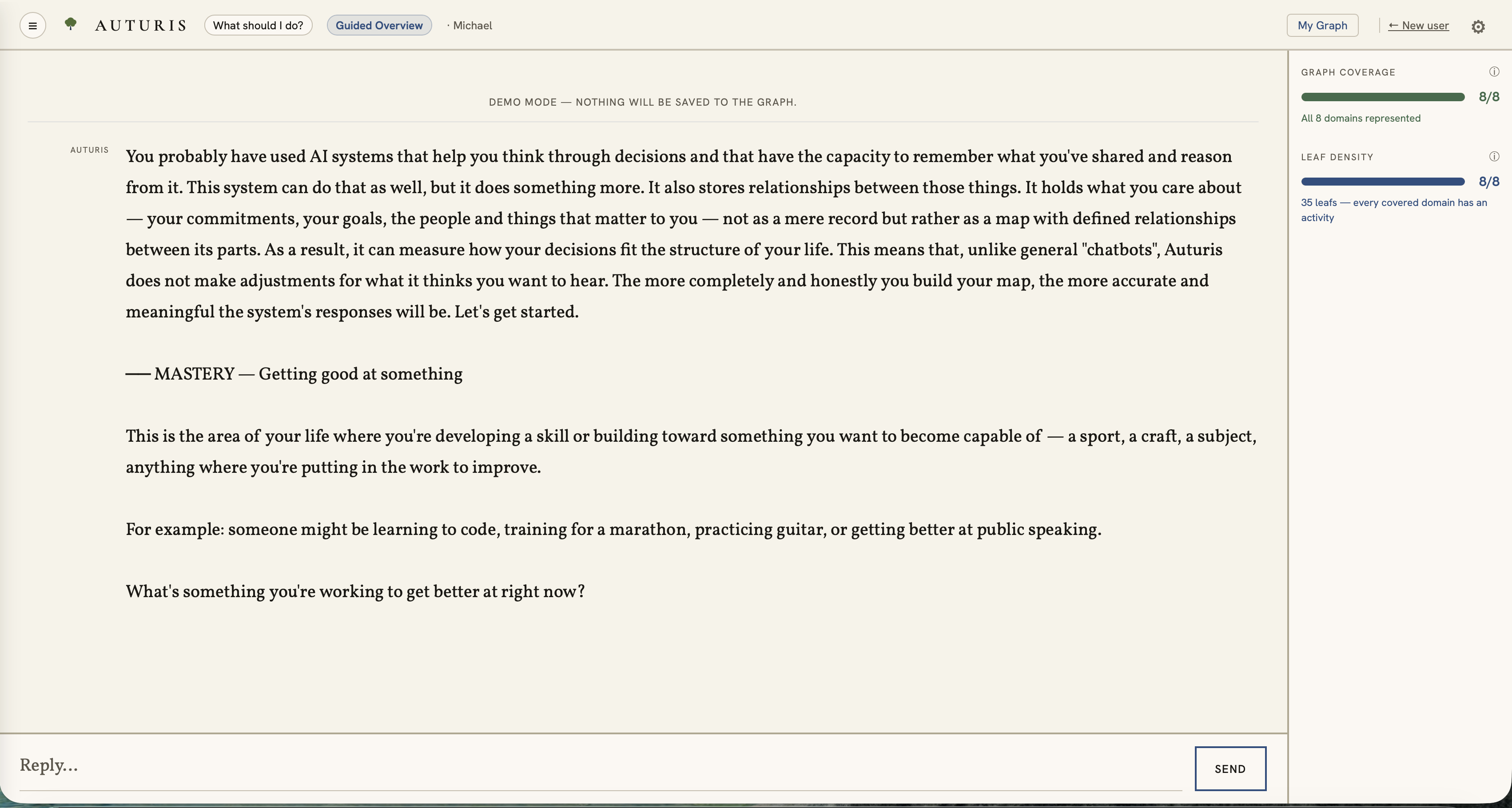
Who this is for and what it does
Auturis is a system for someone who already thinks seriously about
their own choices and who has a problem against which they would
like to test that thinking. Auturis will help you think through
problems that fall under two broad questions: “What should I
do?” and “What is right?” For any circumstance, the
system is designed to help you answer these two questions.
In order to be able to perform this task more effectively than a
“chatbot,” Auturis requires that you first build your
personal or organizational knowledge graph, which is a task with
which it will assist you.
The structured nature of the knowledge graph provides Auturis with
its distinctive advantage. Standard chatbots will, if you grant
permission, make use of your personal information. But this
information exists, figuratively speaking, in a pile, which the AI
must sift through in an attempt to determine the relevance of some
piece of that pile to the current conversation. The graph in the
Auturis system, by contrast, exists as a structured network of
meaning. This map, which the AI accesses, but which remains on your
computer, helps the AI identify the relevance of your personal goals
to the situation at hand.
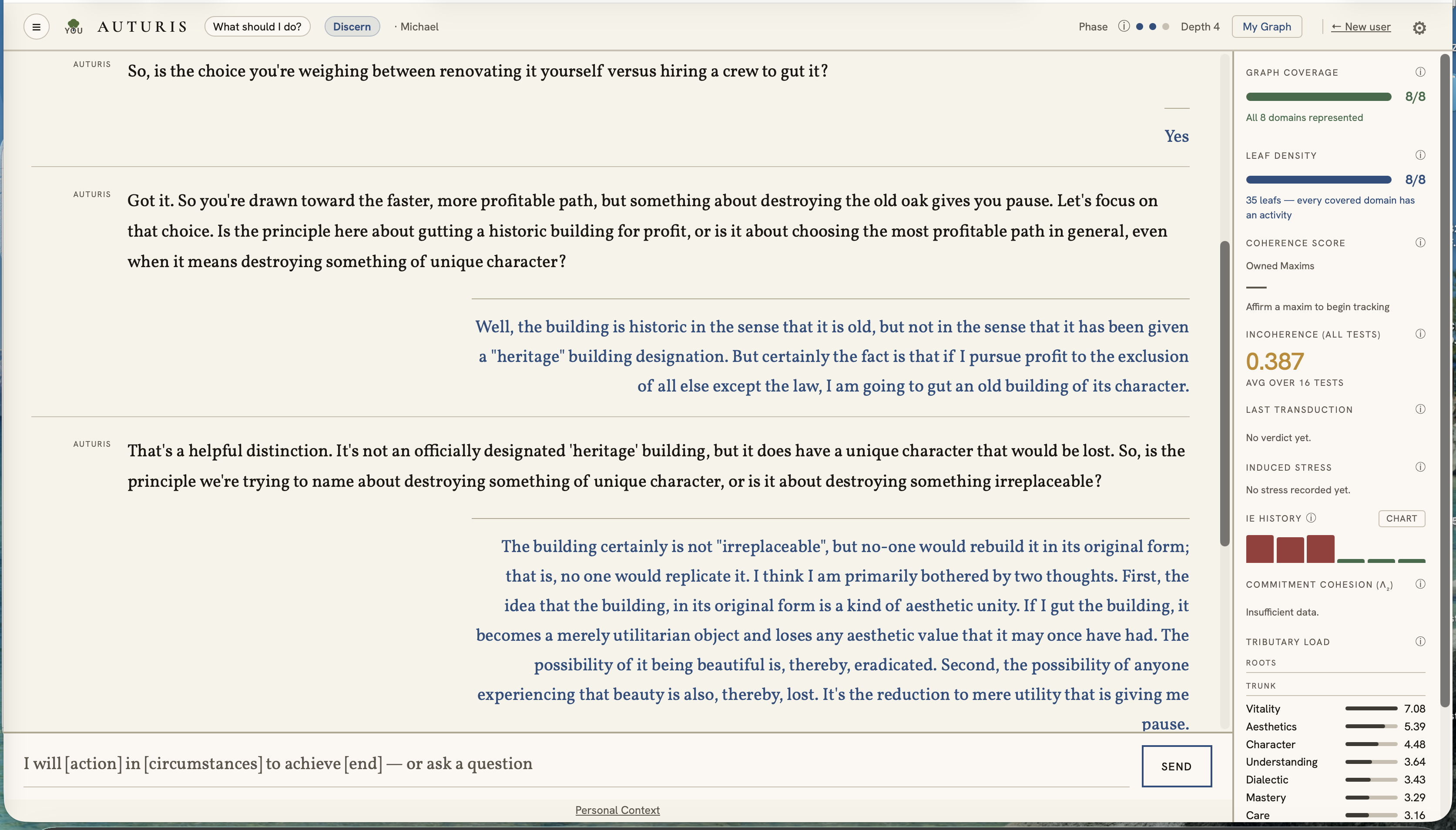
The knowledge graph also provides the Auturis system with the
capacity to determine the degree to which a proposed new action will
fit within your, or within your organization's, existing system of
ends (or values). This metric is then used, together with the
information in your graph, to evaluate your proposed courses of
action. In the case of small groups or organizations, the same graph
structure is used to measure the degree to which a policy hinders
individuals or stakeholders in the achievement of their stated aims.
The data provided by this analysis can be used to assess the
fairness (or rightfulness) of any proposed or existing policy. These
matters are explained in greater detail on the page for each
question: What should I do? and
What is right?
You may find what Auturis has to say to be truly informative, or it
may just tell you something that you already knew, in which case,
you will have further support for your decision.
Auturis' Graph
Auturis works by leveraging a knowledge graph that you build
yourself.
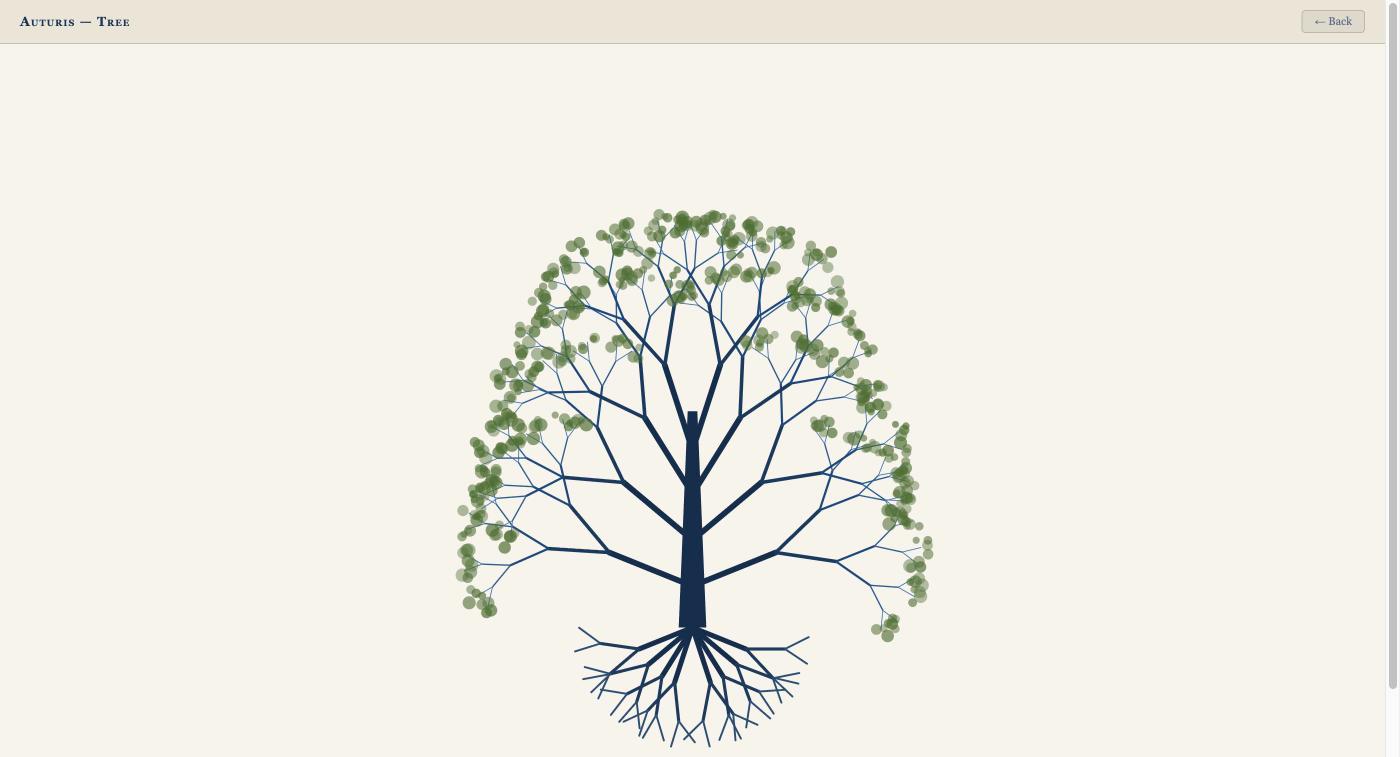
The graph takes the shape of a tree. The roots and boughs of this tree
correspond to essential human ends and domains of practice, which
appear in the list below. You supply the branches and the leaves. The
branches represent your intermediate level goals, such as financial
independence, and the leaves represent the concrete actions that are
required to pursue them, such as opening a bank account.
The eight roots — terminal human ends — and the bough, or domain of
practice, through which each is pursued:
Preservation→Vitality
Justice→Politeia
Freedom→Character
Connection→Dialectic
Flourishing→Care
Agency→Mastery
Beauty→Aesthetics
Reason→Understanding
These are fixed — the system doesn't rename, add to, or remove them.
Whatever you build, and whatever you later test, is checked against
this same structure, not against a mood or a house style.
Start by talking to Auturis
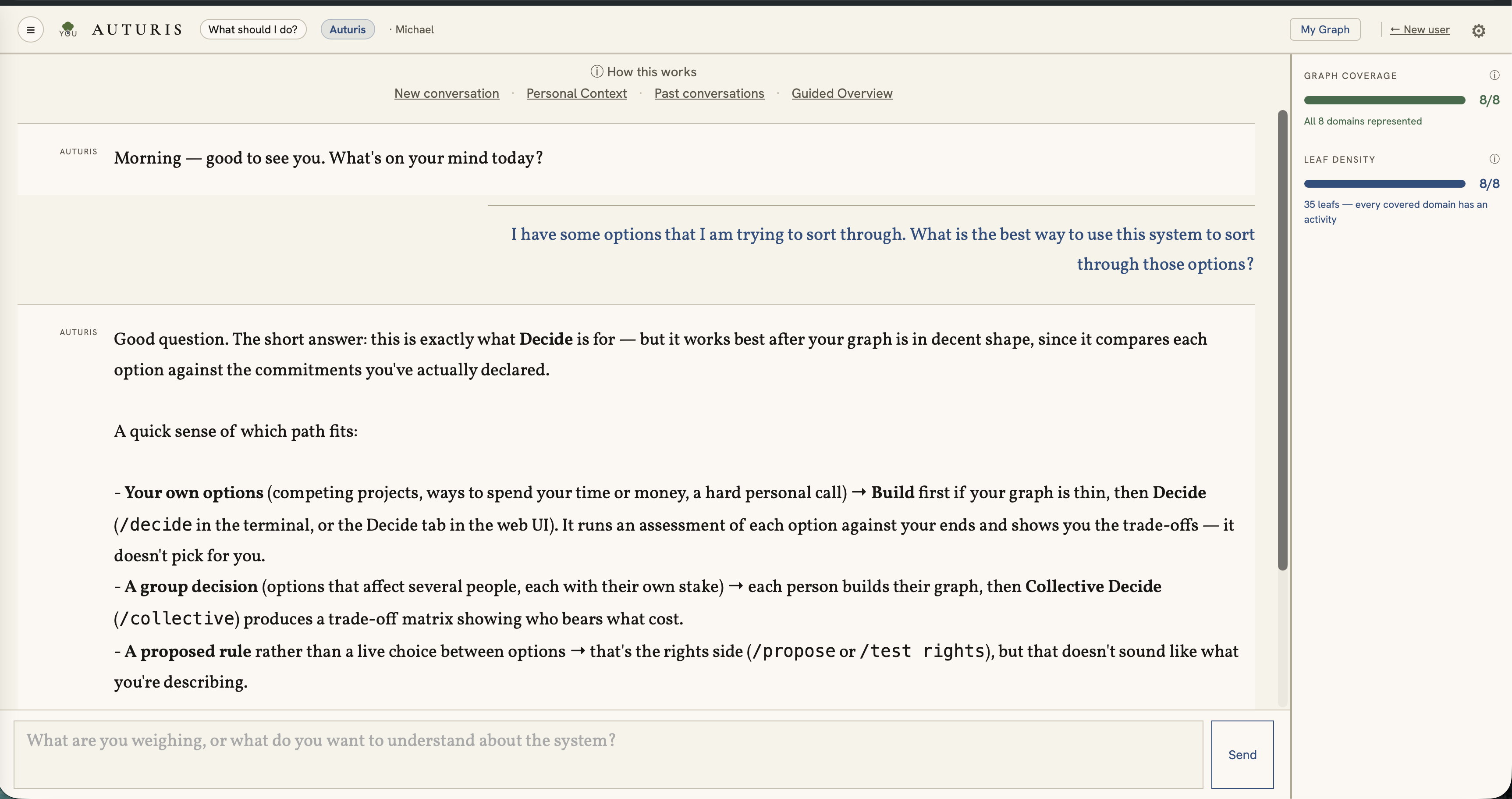
The first tab you land on, once your key is set up, is a conversation.
Auturis greets you and asks what's on your mind. You can ask how the
system works or talk through whatever you are currently facing. If you
have already built your graph, then Auturis will utilize that
information in its discussions with you.
It can also act directly from the conversation. It can run a test on a
maxim or a proposed rule, or add to your graph. It keeps its own
conversation history and can use search when that's actually useful to
what you're asking.
Auturis in the classroom
Auturis also works as a classroom tool, not just an organizational
one. Two ready-to-run lesson plans apply the same hindrance-check and
personal-coherence machinery to a real ELA / U.S. History unit — one
testing a proposed courtroom rule against a play's own stakeholders,
the other adding each character's own moral dilemma on top of it —
backed by a reliability check run before either was written. Neither
has been taught to a real class yet, and both pages say so plainly.
See the educational exemplars
A private beta build. We're looking for testers.
Auturis isn't in the App Store or on the Microsoft Store yet — it's an
early, closely-managed beta. Access is by request, not open download, so
we can actually keep track of who's testing it and hear back from them.
It also runs on your own computer rather than as a website, and that is
deliberate. What you put into Auturis (what you care about, the
decisions you face, and how you weigh them) is too personal to be held
on someone else's server, ours included. Your graph and your history
stay on your machine; each conversation goes only to the AI provider
whose key you use.
Get access
Auturis is in beta. Read the beta-tester agreement,
agree to it, and your download is on the next page.
Available for Windows, Mac (Apple Silicon), and Mac (Intel).
Getting started
Your OS will warn you the first time you try to open this app — that's
expected, not a sign anything's wrong. Auturis is a beta from an
independent developer. It isn't distributed through the App Store or
Microsoft Store, and it isn't signed with Apple's or Microsoft's paid
developer certificates. Those cost money every year, and I'd rather
spend it once there's evidence people want the app. Until then, your
computer can't tell who made it, so it errs on the side of caution.
Find the section below for what you downloaded; the steps take under
a minute.
Windows
- Right-click the downloaded zip and choose Extract All — don't just double-click to open it, since Windows lets you browse inside a zip without actually extracting it, and the app won't run correctly from there. If you double-click
Auturis.exe without extracting first, Windows will warn "this application may depend on other compressed files in this folder" — that's the sign to go back and extract properly. Once it's extracted to a real folder, run Auturis.exe from inside it, keeping it together with the _internal folder next to it.
- Windows will likely show a blue "Windows protected your PC" SmartScreen warning. Click More info, then Run anyway.
Mac (Apple Silicon)
- Unzip and drag
Auturis.app out of the unzipped folder.
- Your Mac will refuse to open it and will very likely only give you the option to put it in the Trash. In order to open it, follow these steps:
- Open Terminal (a built-in Mac app, not something you need to install): press Command (⌘) and Space together, a search box will pop up, type Terminal, then press Return. A window with plain text will open — that's normal, it's just how Terminal looks.
- Select and copy the line below (click into it, then Command+C):
xattr -cr ~/Downloads/Auturis.app
click into the Terminal window, paste it in (Command+V), and press Return. (If you moved the app somewhere other than the Downloads folder, replace ~/Downloads/ with the folder you moved it to.)
What this does: when you download a file, your Mac attaches a "quarantine" tag to it. This command removes that tag from Auturis.app only — nothing else on your Mac, and it doesn't change any security settings.
- Close Terminal, then double-click the app again — it should open normally.
Mac (Intel)
- Unzip and drag
Auturis.app out of the unzipped folder.
- You'll likely hit the same Trash-only message as the Apple Silicon build, for the same reason — no paid Apple certificate yet. Fix it the same way:
- Open Terminal (a built-in Mac app, not something you need to install): press Command (⌘) and Space together, a search box will pop up, type Terminal, then press Return. A window with plain text will open — that's normal, it's just how Terminal looks.
- Select and copy the line below (click into it, then Command+C):
xattr -cr ~/Downloads/Auturis.app
click into the Terminal window, paste it in (Command+V), and press Return. (If you moved the app somewhere other than the Downloads folder, replace ~/Downloads/ with the folder you moved it to.)
What this does: when you download a file, your Mac attaches a "quarantine" tag to it. This command removes that tag from Auturis.app only — nothing else on your Mac, and it doesn't change any security settings.
- Close Terminal, then double-click the app again — it should open normally.
Once it's open: you'll be asked for your own API key on first launch
(BYOK — bring your own key; see further down the page for how to get
one, it takes a couple of minutes). Then give it a real question or
decision you're actually facing — that's where it gets interesting.
If you have a Claude subscription, you can skip the key and use parts of
Auturis through Claude instead — see the next section.
Using Auturis with your Claude subscription
If you have a Claude subscription, you can run parts of Auturis through
Claude, with no API key: in the Claude desktop app's Code tab, or in
Claude Code in a terminal. Auturis's own model calls then run on your
Claude plan.
With the plug-in
- What should I do? Test a maxim: whether your principle holds if everyone acted on it.
- What is right? The full rule check: record the groups a rule reaches, state the rule, see what it does to each.
Needs an API key
- Your own graph: building it, seeing it, testing against your own commitments
- The guided dialogue for finding your maxim
- Decide, for yourself or as a group, and Mediate
To set it up, install the Auturis app and keep it open, then give Claude
Code this command:
/plugin marketplace add https://auturis.com/plugin/marketplace.json
then /plugin install auturis@auturis. In the desktop app's
Code tab, add the same address under + → Plugins. The plug-in comes
with the app: use the plug-in, an API key, or both.
Talk to a full model
From October 9, Google's free Gemini offers only Flash-Lite, its smallest
model. Flash and Pro now need a subscription.
The matters Auturis exists for are of no small importance to you, so we
test models for the capacity for deep reasoning before we recommend them
(our test results). In Auturis you know which model
answers you, and it is one we have tested. You can talk with it about
anything, not only the questions Auturis was built for.
With your own key you pay only for what you use. On GLM-5.3, the model
Auturis itself runs on, a message costs a cent or two, so for most people
this costs less than a monthly subscription. Your messages go only to
hosts that keep no copy of them and do not train on them.
Obtaining your own key
Auturis talks directly to an AI provider using a personal "API key" —
like a password just for this. It takes a couple of minutes to get
one, no coding involved, and you only pay for what you actually use
(usually pennies per conversation). Paste it in where Auturis asks.
Never done this before? Step-by-step instructions are here.
Please note that our tests suggest that only undistilled frontier
models are able to perform reliably within the Auturis system. Of the
models that we have tested, the following are recommended: GLM-5.3, an
open-weight model reached through OpenRouter (what Auturis now runs on),
Gemini 2.5 Pro, and Claude Opus (test results). Claude Sonnet, while
slightly less reliable, may prove sufficient for your purposes.
Smaller, cheaper, and free-tier models generally fail our tests. Since
there is no general way to know whether a given model is distilled, we
recommend that you run whichever model you choose against our "model
compatibility check," which is contained within the Auturis program.
Recommended
Gave Auturis the most reliable reasoning in our own testing.
The cheapest of the recommended options, and the one Auturis itself now runs on. GLM-5.3 is an open-weight model: its makers can't quietly swap in a cheaper one under the same name, and no company can retire it on its own schedule. Sign up, add credit, click Keys, create one, copy it. Auturis sends your requests only to hosts that keep no copy of them and don't train on them.
Google's model. Sign up, click Get API key, create one, copy it. Auturis uses 2.5 Pro. Google hasn't announced a shutdown date, but it now limits 2.5 Pro to accounts that have used it before, so a brand-new Gemini key may not work with Auturis. If you're starting fresh, Claude is the safer choice.
Highest quality, higher cost. Sign up, click API Keys, create one, add a payment method — then pick Opus as the model in Auturis.
Same account and key as Opus — just pick Sonnet as the model instead. Cheaper, still solid.
Still workable
Works fine, though it scored lower than the ones above in our own testing.
Sign up, open your account menu → API keys, create one, add a payment method.
Was our top recommendation, moved down until further notice: DeepSeek quietly swapped in a new model (V4-Pro) behind the same name in mid-August with no warning, and it's been inconsistent in our testing since; its prices also rose sharply in August. Still usable, just not the safe default it was.
* OpenRouter keys work in the Mac (Apple Silicon) and Windows downloads
now. The Intel Mac download will accept them in its next update;
until then, use one of the other keys there.
Your key stays on your own computer. Auturis sends it only to the
provider you got it from, never anywhere else.
A Clarification
With some familiarity with this system, it may be objected that once
your maxim or your policy rule is identified, you already know
whether the proposed action is good or the rule is rightful; that
this system, therefore, is not telling you anything that you cannot
already determine for yourself without it. But this objection misses
the mark. The point of the system is not to be an oracle. It is
rather to bring things into the light, which might otherwise never
see it, and to bring confidence to those who may need it.